
High-Probability EUR/JPY Entry Points are essential for traders aiming to navigate the EUR/JPY currency pair, one of the most actively traded crosses in the forex market. This pair combines the euro’s exposure to European economic conditions with the Japanese yen’s role as a safe-haven currency. Traders are drawn to EUR/JPY because of its relatively high volatility, strong technical patterns, and sensitivity to global risk sentiment. However, volatility can be a double-edged sword: it creates opportunities for big gains but also increases the potential for losses if entry points are poorly timed. Identifying high-probability setups is therefore crucial for traders looking to maximize profitability while managing risk.
Step 1: Understand the Fundamental Drivers

The first step in identifying quality entries is to grasp what fundamentally moves EUR/JPY. The euro is heavily influenced by European Central Bank (ECB) monetary policy, economic growth indicators such as GDP and inflation, and political events within the Eurozone. On the other hand, the yen is driven by Bank of Japan (BoJ) policy, Japanese economic health, and most importantly, global risk sentiment. During periods of uncertainty, investors often flock to the yen, pushing EUR/JPY lower. Conversely, when markets are optimistic, capital tends to move into higher-yielding assets, which supports the euro against the yen.
By staying updated on interest rate decisions, policy statements, and global news flows, traders can avoid being blindsided by sudden volatility and align their trades with prevailing macroeconomic trends.
Step 2: Use Technical Analysis to Spot Setups
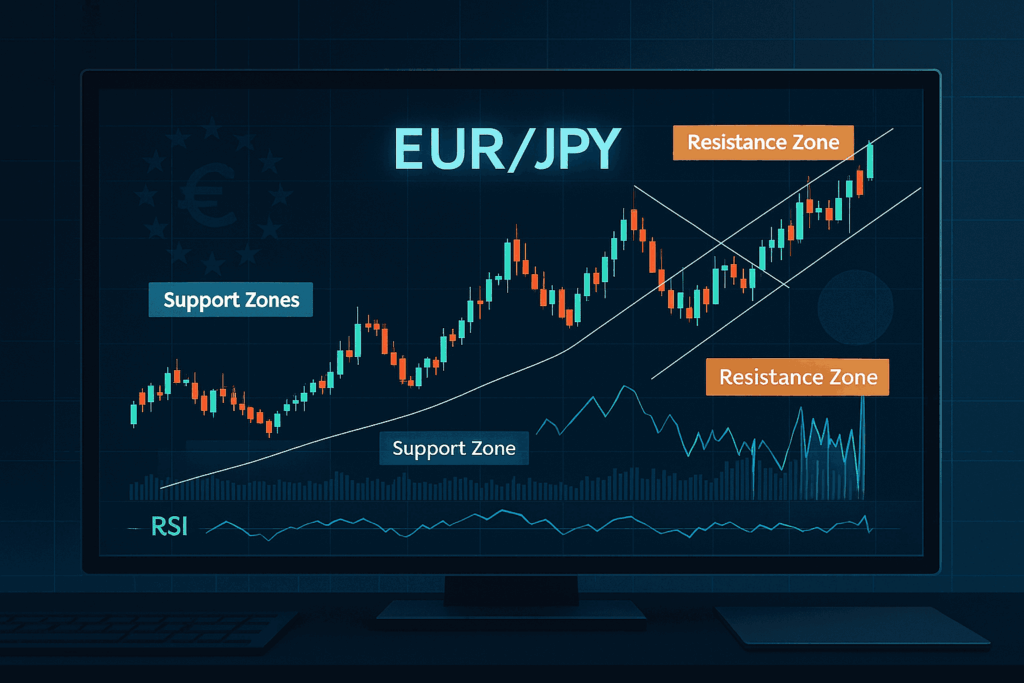
Once fundamentals provide the backdrop, traders turn to technical analysis to pinpoint entry opportunities. Key tools include:
- Support and Resistance Levels: Identifying horizontal zones where price has historically reacted is essential. These areas often act as decision points where high-probability entries can be made. For instance, if EUR/JPY approaches a strong support level after a retracement, it may present a buying opportunity.
- Trendlines and Channels: Drawing clean trendlines helps highlight the broader direction of the market. Trading in the direction of the trend generally increases the odds of success.
- Candlestick Patterns: Reversal signals like bullish engulfing patterns near support, or bearish shooting stars near resistance, can provide confirmation for entries.
- Indicators: Moving averages (such as the 50-day or 200-day) are useful for gauging trend direction, while oscillators like RSI and Stochastics can reveal overbought or oversold conditions.
Step 3: Combine Timeframes for Confirmation
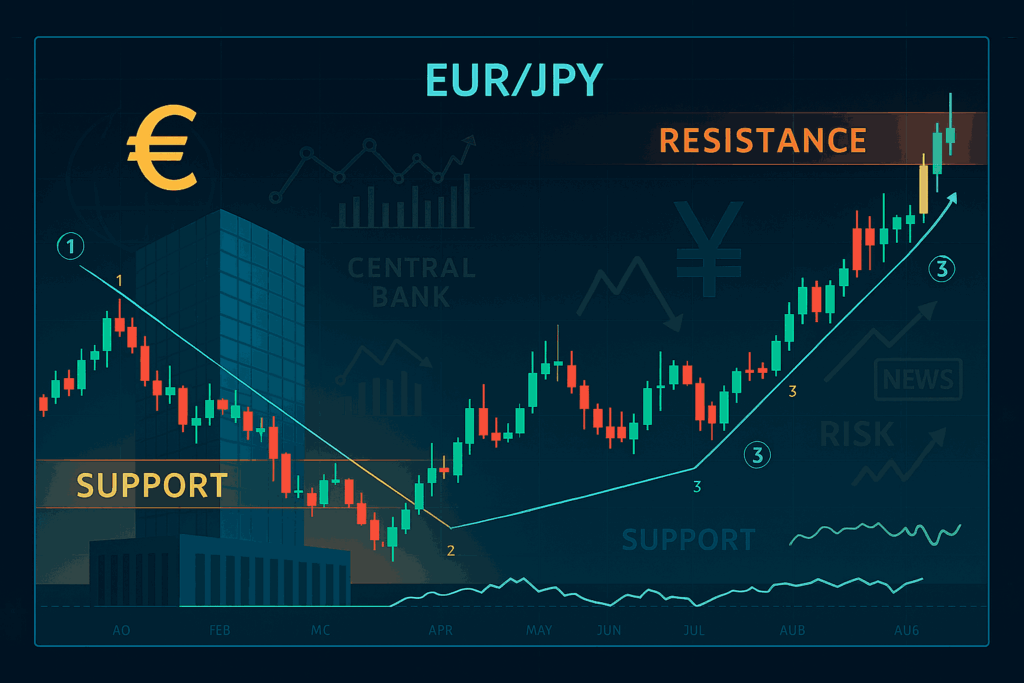
One of the best ways to improve accuracy is multi-timeframe analysis. For instance, if the daily chart shows EUR/JPY trending upward, a trader might look to the 4-hour or 1-hour chart to find precise entry triggers such as pullbacks or consolidations. This ensures that trades are aligned with the larger trend but fine-tuned for better risk-to-reward setups.
Step 4: Watch Correlations and Risk Sentiment

Because the yen is highly sensitive to global risk appetite, monitoring equity markets, bond yields, and risk indicators like the VIX can provide context for EUR/JPY movements. For example, a sudden spike in risk aversion often leads to yen strength, making short setups more favorable. Additionally, cross-checking EUR/JPY against related pairs such as USD/JPY and EUR/USD can help confirm momentum and avoid false signals.
Step 5: Define Entry Triggers and Risk Management

Even with strong technical and fundamental confluence, risk management must guide every entry. Traders should define exact entry criteria such as waiting for a retest of support with a bullish candlestick confirmation and pair this with stop-loss placement just beyond the identified level. For high-probability trades, the risk-to-reward ratio should ideally be at least 1:2. This ensures that even if some trades fail, the overall strategy remains profitable.
Final Thoughts

Identifying high-probability EUR/JPY entry points requires a structured approach: understanding the pair’s fundamental drivers, analyzing technical setups, confirming trades across multiple timeframes, and monitoring correlations. By combining these elements with disciplined risk management, traders can improve consistency and confidence in their trades. While no setup guarantees success, patience and adherence to a process can dramatically increase the odds of catching profitable moves in EUR/JPY.